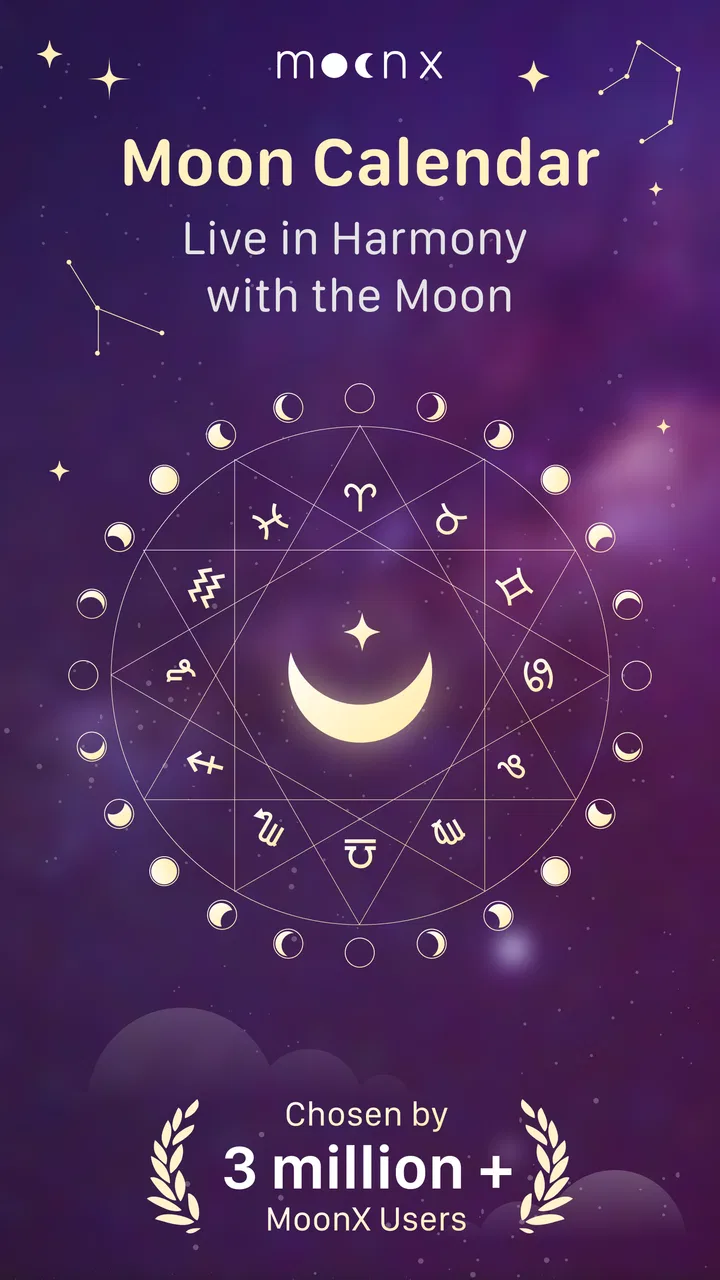
Moon Phase Calendar - MoonX
- 4.6
- Rating
- 1.00M
- Installs
- Free
- Price

 Analysis by App-foxy
I usually approach moon and astrology apps with a little caution. They can be relaxing and useful for building a personal routine, but they can also become cluttered with vague predictions or too many locked sections. After spending time with MoonX, I found a more focused experience: it combines a moon phase calendar, astrology tools, horoscopes, and birth-chart information in one lifestyle app. Its strongest quality is not that it tries to prove anything about the sky or about personality; it gives you a simple way to observe cycles and use them as prompts for reflection.
MoonX feels best when you treat it as a personal planning and journaling companion, not as a medical tool or a source of certainty. That distinction matters because its store summary connects the moon and astrology with mental health, while the actual value for me came from creating moments to pause, check in with myself, and think about patterns. If you enjoy astrology, want a clearer moon calendar, or like having birth-chart material in a single place, this free Lifestyle app is worth exploring. If you want evidence-based mental-health guidance or a bare calendar with no spiritual layer, I would choose something else.
How MoonX feels in everyday use
The main appeal is the way the app brings several related subjects together. Instead of switching between a moon-phase calendar, a horoscope service, and a separate birth-chart website, I can use one interface to move between them. That makes the experience more coherent, especially when I want to connect a current lunar phase with a broader astrology reading.
You May Also Like

 Blood Strike: 2.5 Anniversary
Blood Strike’s Loadouts Turn Every Drop Into a Tactical Gamble
A close look at Blood Strike’s custom loadouts: how fast access to signature weapons reshapes its battle royale rhythm, rewards preparation, and narrows the gap between fights.

 Pandora - Music & Podcasts
Pandora’s Music Is Easy to Start, but Harder to Recover
Pandora’s strength is its low-effort path from a seed to a station. Its weak spot is how much confidence it asks you to place in connection, setup, and quiet recovery.

 8 Ball Pool
 Is Built on Rivalries, Rematches, and Routine
A close look at the rivalries, rematches, shared routines, and unanswered safety questions that turn a quick pool match into a persistent mobile community.

 Samsung Music
’s Quiet Strength Is Playing What You Already Own
Its reach comes less from spectacle than from dependable access to a personal library. That simplicity is both the app’s strongest retention engine and its ceiling.

 AccuWeather: Weather Radar
AccuWeather Review: A Quick, Clear Forecast for Everyday Decisions
For everyday plans, the best forecast is the one you can understand quickly. AccuWeather makes rain timing, radar, and local conditions easy to act on, with a few trade-offs.

 Hill Climb Racing
Why Hill Climb Racing Still Turns Crashes Into One More Run
A tiny car, a bumpy hill and one more upgrade: Hill Climb Racing keeps resurfacing because its simple chaos makes every near-miss feel personal.
More From Our News Desk



The moon calendar is the most practical starting point. I can open it when I want to know where the moon is in its cycle, then use that information as a small planning cue. For example, I might check it in the morning before deciding what kind of evening routine I want: a quieter review of the week, a short journal entry, or simply a reminder to step away from a busy screen. The app does not need to control my schedule to be useful; it works better as a gentle prompt.
That workflow is more helpful than opening a horoscope at random and scrolling until something sounds familiar. I prefer checking the calendar first, reading the relevant astrology material second, and then deciding whether any of it actually speaks to my situation. This keeps the experience personal rather than passive. It also reduces one of the common problems with horoscope apps: letting a general paragraph dictate how I interpret an entire day.
The birth-chart area gives the app a more individual feel than a simple daily horoscope. A general sign-based reading is easy to find anywhere, but a birth chart encourages a slower look at personal astrology. I would recommend taking time to enter details carefully and reviewing the result when you are not distracted. A rushed first look can make the chart feel like a wall of unfamiliar terms, while returning to one section at a time makes it easier to understand.
A useful routine for people who dislike complicated wellness apps
One of my favorite ways to use MoonX is as a three-minute check-in. I open the current moon information, read the horoscope without treating it as a command, and write down one sentence about my mood or main concern. The important part is the order: observation first, interpretation second, personal response last. That makes the app a prompt for self-awareness instead of a replacement for my own judgment.
This routine also shows where the app fits among alternatives. A dedicated meditation app will usually offer more structured exercises, while a conventional calendar is better for appointments and reminders. A specialist astrology service may go deeper into chart interpretation. MoonX sits between these options. It is broader than a moon calendar, less intensive than a therapy or meditation platform, and more convenient than collecting several astrology tools separately.
That middle position is a real strength, but it is also a trade-off. You get variety and convenience rather than deep instruction in one discipline. I would not install it expecting a complete mental-health program, a professional astrological consultation, or a scientifically validated mood tracker. I would install it because I want a calm, accessible way to explore lunar cycles and astrology while keeping the experience connected to everyday reflection.
What the current release tells me about the product
The current version is 2.9.11, which suggests a product that has moved beyond an early experiment and is being maintained as an established app. I would not read that version number as proof that every part is equally polished, but it does make the app feel more mature than a newly launched moon calendar. The developer is LLC VIBES, and the app has been available since July 28, 2020, giving it a substantial period to develop its identity around moon information, horoscopes, and birth charts.
Its audience is also broad. MoonX has passed one million installs and holds a 4.6 average from around twelve thousand ratings, with roughly seven hundred twenty written reviews. Those figures make it easier for me to recommend trying the free version, although popularity does not remove the need to decide whether the astrology style suits you. The app is rated for Everyone, which matches its generally accessible subject matter, but younger users should still understand that astrology content is entertainment and reflection rather than professional advice.
The free entry point is important because it lowers the risk of testing the experience. At the same time, in-app purchases range from $0.99 to $99.99 per item. That is a wide spread, so I would explore the free areas first and pay close attention to what a purchase unlocks before confirming anything. I would especially avoid buying while browsing casually late at night, when an attractive interpretation or extra feature can make an upgrade feel more urgent than it really is.
For existing users, the current release is likely most valuable as a continuation rather than a complete change of direction. The core idea remains recognizable: use lunar information and astrology as an accessible lifestyle experience. People who already built a habit around checking moon phases should find the current version familiar in purpose, while newer users get a more developed starting point than they would from a minimal calendar.
Small details that improve the experience
A useful but easy-to-miss habit is to separate reading from reacting. I recommend opening the app once to see the moon phase and chart material, then closing it before deciding what it means. Later, I can compare the reading with what actually happened. This prevents confirmation bias from taking over and gives the app a more reflective role. It also makes repeated use more interesting because I am observing my response rather than searching for a prediction that must come true.
Another practical tip is to use the birth chart as a reference library instead of trying to understand everything in one sitting. Astrology charts contain several layers, and a first session can become overwhelming if I jump between every available interpretation. I get more from choosing one element, noting what feels relevant, and leaving the rest for another day. MoonX works better for me when I treat it as something to revisit, not a test I need to finish.
I also find the app more useful during transitions. On a Sunday evening, for instance, I might check the moon calendar, read the day’s horoscope, and write down one intention for the coming week. The intention does not have to be mystical. It could be “protect an hour without notifications” or “finish the task I keep postponing.” In this setting, the lunar information gives the routine a theme, while the actual decision remains practical and personal.
These workflows are not obvious from a short store description, but they are where the app earns its place on my phone. The value comes from combining information with a repeatable behavior. Without that habit, MoonX can become another app I open, scroll through, and forget. With it, the content becomes a small structure for reflection.
Where the experience can become frustrating
The broad feature set has a cost: the app can feel less focused than a dedicated tool. If I only want to know the current moon phase, the horoscope and birth-chart sections may feel like extra material around a simple answer. Conversely, if I want detailed astrological education, the app may feel too streamlined. It introduces several topics efficiently, but that does not necessarily make it the best deep-dive resource for any one of them.
The mental-health framing also deserves a careful boundary. MoonX can encourage journaling, mindfulness, and emotional check-ins, but I would not use it to assess symptoms, manage a crisis, or replace a qualified professional. A horoscope can be comforting or thought-provoking, yet it should not determine treatment, medication, financial decisions, or major relationship choices. Anyone looking for structured cognitive exercises, clinical support, or measurable mood tracking will probably be better served by a purpose-built health app or direct help from a professional.
There is also a financial consideration. Starting free is convenient, but the presence of paid items means I would not assume every useful section is included without checking the screen carefully. The broad purchase range makes it particularly important to distinguish a one-time curiosity from a feature I expect to use regularly. If I only want occasional moon-phase information, paying for extensive astrology content may not be worthwhile.
Another limitation is interpretive rather than technical: astrology content can feel personal even when it is broadly written. I sometimes recognize myself in a passage because I am already thinking about that subject. That does not make the reading useless, but it means I should keep a little distance. The best experience comes from asking, “Does this help me reflect?” rather than “Is this definitely predicting my day?”
Who should install it, and who should skip it
I would recommend MoonX to someone who enjoys astrology but wants more than a single daily sign reading. It is also a good fit for people who like moon-phase calendars, reflective routines, and gentle prompts that can be used without committing to a full wellness program. Beginners may appreciate having the calendar, horoscope, and birth-chart tools together instead of learning several unfamiliar apps at once.
It is less suitable for someone who wants a completely secular wellness experience. If references to astrology or lunar cycles feel distracting, the app may get in the way of the habits you are trying to build. I would also skip it if my main goal were professional-grade chart analysis, detailed astronomy, or a clinical approach to mental health. In each of those cases, a specialist alternative would be more precise.
People who dislike subscriptions and in-app purchase prompts should approach the free version deliberately. I would use it for a while, identify the functions I actually return to, and only then consider spending money. The app’s free price makes that trial straightforward, but the purchase options mean it still rewards a little patience.
What I would watch as the app continues
Because the app is already at version 2.9.11, I would pay attention to whether future updates make the experience clearer without making it busier. The best direction would be smoother movement between the moon calendar, horoscope, and birth chart, with explanations that help beginners without flattening the subject for experienced users. I would also value transparent distinctions between reflective content and mental-health guidance.
For current users, the practical question is whether updates preserve the calm, quick check-in that makes the app convenient. If new material adds depth while keeping the calendar easy to reach, that would strengthen its position between a basic moon tracker and a full astrology service. If the interface becomes dominated by locked content or constant prompts to upgrade, the original simplicity would be harder to maintain.
I would also watch how well the app serves two different audiences: people who want a quick daily glance and people who return to their birth chart for longer study. Those users need different levels of detail. A good balance would let me get a fast answer about the moon without preventing a slower, more personal exploration when I have time.
After using it, my opinion is positive but measured. MoonX is not a substitute for therapy, an astronomy reference, or a professional astrology reading. It is a free lifestyle app that brings lunar cycles and astrology into an approachable daily format, with enough variety to support a personal routine. I like it most when I use it as a prompt to pause, write, and notice my own reactions.
If you want an easygoing moon and astrology companion rather than a source of absolute answers, MoonX is a worthwhile download. Start with the free experience, build a simple check-in around the calendar, and judge the readings by whether they help you think more clearly. That approach lets the app’s strongest qualities stand out while keeping its limitations in the right perspective.
FAQs for Moon Phase Calendar - MoonX
01What is Moon Phase Calendar - MoonX used for?
Moon Phase Calendar - MoonX is designed to help you follow the Moon’s current phase and upcoming lunar cycle. It typically provides a visual lunar calendar, illumination details, moonrise and moonset information, and additional astronomical data. It can be useful for casual skywatching, planning photography, checking full and new moons, or exploring astrology-related information in one place.
02Does MoonX provide accurate moon phase and astronomical information?
The app is generally useful for everyday moon tracking because its calculations are based on astronomical data and your selected location. However, results such as moonrise, moonset, and visibility can vary slightly depending on location settings, time-zone accuracy, device permissions, and atmospheric conditions. For professional astronomy, navigation, or scientific observation, users should verify important details with an official astronomical source.
03Can I use MoonX without an internet connection?
Some basic features, such as viewing previously loaded moon phases or calendar information, may remain available offline. Nevertheless, the app may need an internet connection to download updated data, display location-based information, synchronize content, or load certain articles and visual materials. If you plan to use it outdoors, open the relevant calendar and location pages beforehand and make sure your device’s date, time, and location settings are correct.
04Does Moon Phase Calendar - MoonX include astrology or personalized content?
MoonX may include astrology-oriented interpretations, zodiac-related information, lunar recommendations, and personalized content in addition to its astronomical calendar. These sections are intended for entertainment, reflection, or personal interest rather than medical, financial, or scientific decision-making. The exact features and level of personalization can depend on the app version, your profile details, location, and whether optional premium content is enabled.
05Is Moon Phase Calendar - MoonX free to download, and are there in-app purchases?
The app may be available as a free download while offering optional subscriptions or in-app purchases for expanded features, premium forecasts, additional content, or an ad-free experience. Before confirming a purchase, review the price, billing period, trial conditions, and cancellation rules shown in the App Store or Google Play. Availability and pricing can differ by country, platform, and promotional offer.
Pros
- Clear lunar phase calendar with accurate daily moon information.
- Includes moonrise
- moonset
- and illumination details for planning activities.
- Useful widgets provide quick access to current moon data.
- Notifications can remind users about upcoming lunar phases.
- Clean interface makes essential moon details easy to find.
Cons
- Some advanced features may require a subscription or in-app purchase.
- Advertising can interrupt the experience for users on the free version.
- Astronomy data may vary slightly depending on location settings.
- The app can use extra battery when location tracking is enabled.
- Some features may feel excessive for users seeking only the current moon phase.

Moon Phase Calendar - MoonX
Gallery